Oct 27, 2018
The Suspense Movie 'Searching' Is a Film YouTubers Should Go See Right Now
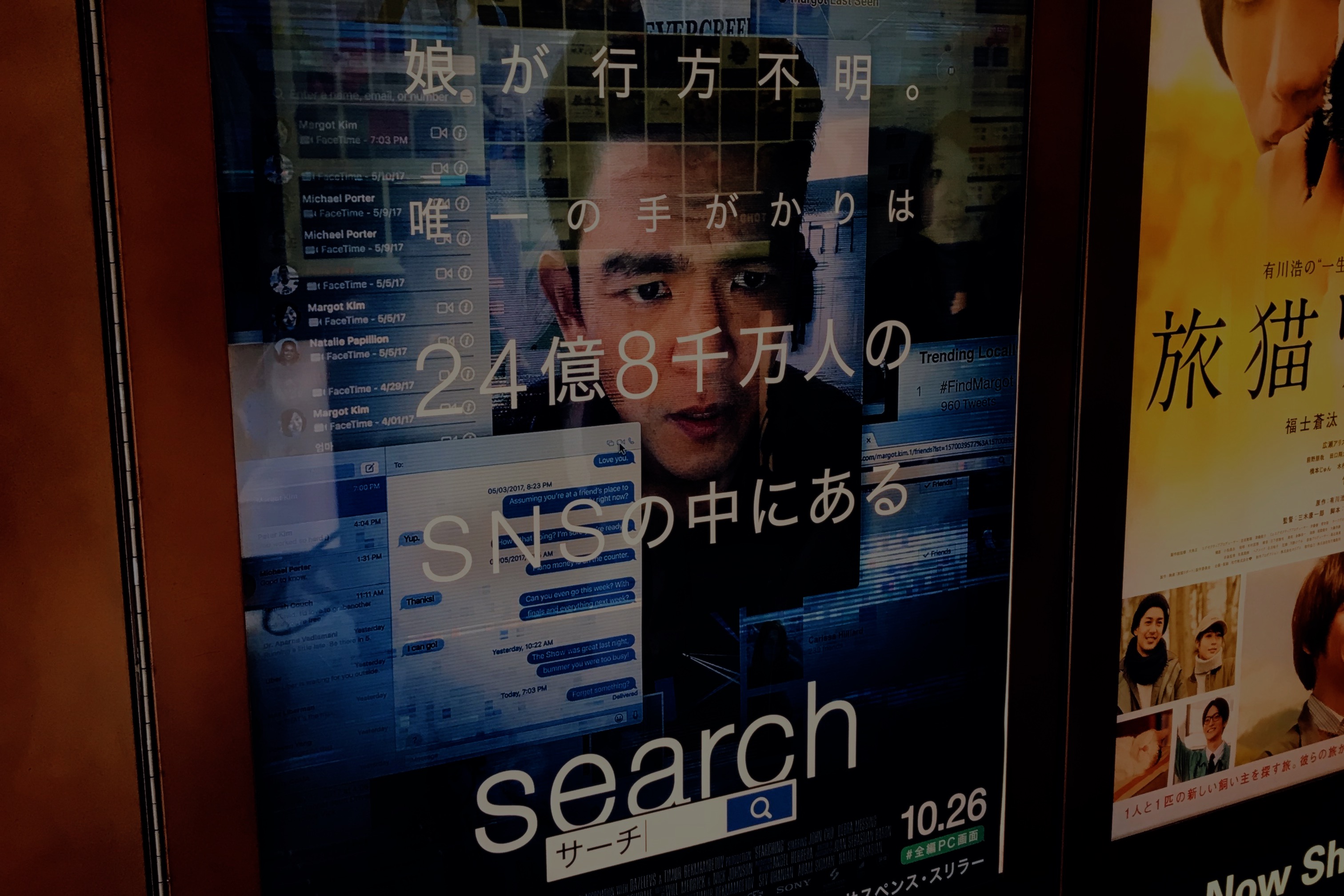
I went to see “Searching,” a fresh-feeling suspense film that’s drawing comparisons to “Camera o Tomeru na!” (One Cut of the Dead) as the overseas equivalent in terms of how it’s gone viral.
On Filmarks — which I always rely on — it was scoring a high 4.1 (as of 2018/10/27), and I’d been curious about it even before its release.
Here’s the Filmarks intro:
The suspense thriller “Searching” won the Audience Award at the 2018 Sundance Film Festival. It opened in just 9 theaters in the US, but with a per-theater gross of $40,000, it ranked No. 1 among all films in release! Rolling Stone praised it: “What a fresh cinematic technique!” The buzz quickly led to expanded screening counts. It has the same kind of momentum as Japan’s “One Cut of the Dead,” which was a sensation everywhere this year.
Savor the New Film Language: “Screenlife”
The first thing making waves is the technique. The film is literally 100 minutes of nothing but a PC screen. That’s the innovative style.
Before seeing it, I was pretty skeptical: “Wouldn’t 100 minutes of just a PC screen get pretty painful?” But it had me by the first 5 minutes. Smart. Aha. Didn’t see that coming. Just one after another. The 100 minutes flew by.
Within the constraint of “only a PC screen,” I wondered how a feature-length film could even hold together — but the direction is masterful.
Every little mouse movement, every pause between keystrokes — the characters’ inner lives are depicted through their interactions with “the PC” (= Screenlife). The visual constraints actually produce a lot of new inventions.
This is a must-see for anyone who works with video or the internet. And more than that, I felt like the presentation techniques would be hugely instructive for YouTubers.
For modern people who spend most of the day in front of a screen, this will become a historic film. You should really experience the essence of “Screenlife,” the new film language championed by producer Timur Bekmambetov.
※ Screenlife The new film language proposed by filmmaker Timur Bekmambetov. Just by watching what’s happening on a browser — how the cursor moves, what gets selected, how the keyboard is typed — the user’s ever-shifting intentions and concerns, their emotions, are revealed in a highly visual form.
A Modern Work, Only an Internet-Generation Director Could Make
This film was directed by 27-year-old Indian-American director Aneesh Chaganty, making his feature debut. At 23, his short film “Seeds,” shot entirely on Google Glass, hit over a million views on YouTube in 24 hours and went viral. After that, he was invited to Google’s Creative Lab in NY, where he worked on Google ads for two years before making his feature debut with this film.
The little “yeah, that’s how it goes online” touches feel really natural for anyone who lives online — there’s a real sense of reality.
Apparently about 20% was shot on iPhone, with Twitter, Facebook, Instagram, Skype, Tumblr, and even live-streaming services all featured — making it a film that could only have been made in this era.
Beautifully Crafted Story with Carefully Planted Foreshadowing
Beyond the visual technique, the story itself is gripping. Twists, turns, rhythmic pacing — and a plot you can’t predict. It’s just genuinely excellent suspense.
The shell-like format eliminates pointless scenes, drawing you deep into the story. The way it pays off its foreshadowing is also superb.
A Must-See for Anyone Working in Video or the Internet
For young people who’ve grown up with the internet as the default, the real world might just be the world they see through a PC screen.
The fact that a 100-minute film exists entirely on a PC screen — and feels completely natural — might itself speak to that. Aneesh, the director, is something else.
YouTubers — stop editing right now and go see this film.