Nov 07, 2016
Reading 'Zero to One' by Former Pepper Lead Kaname Hayashi
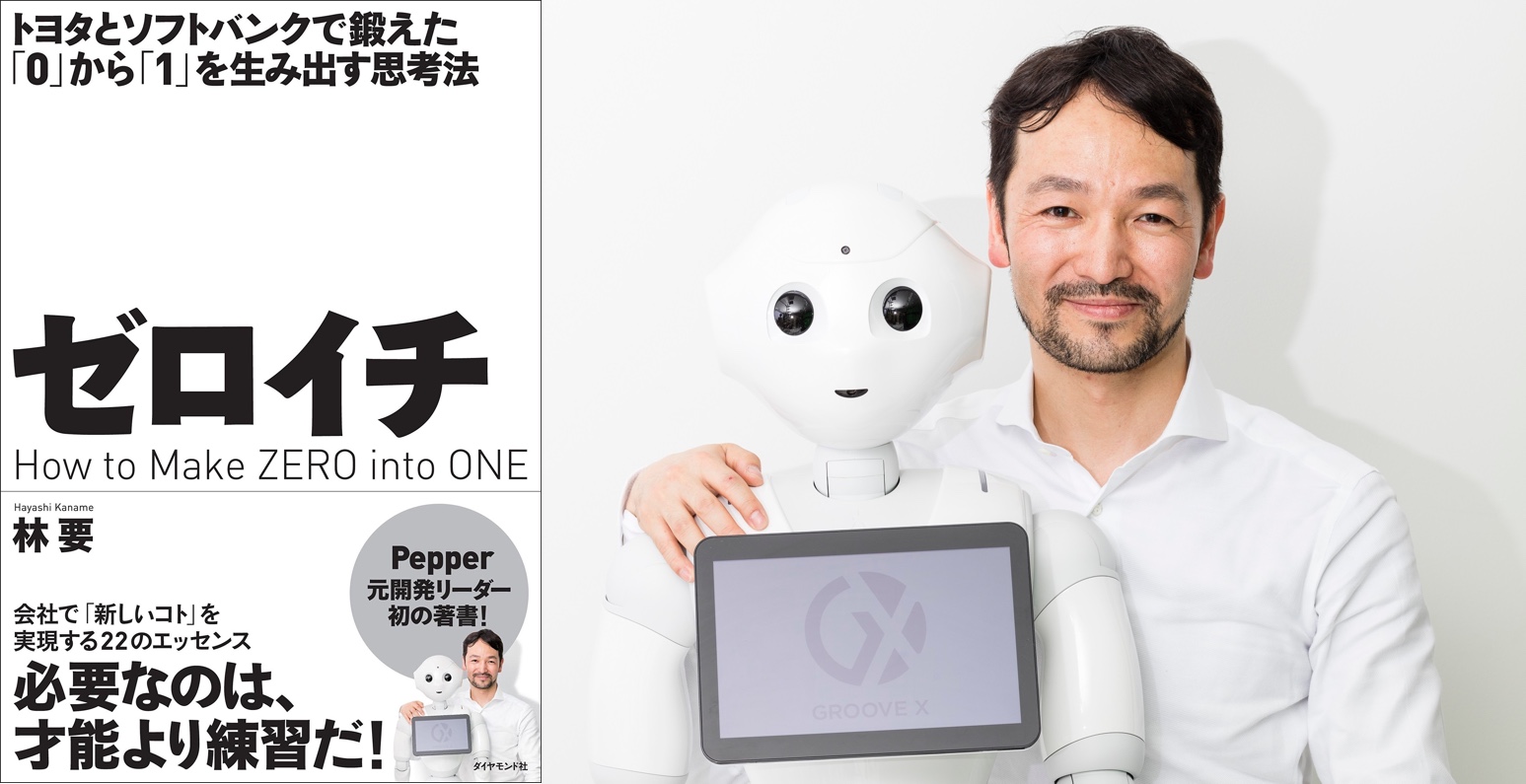
Kaname Hayashi, known as the former lead developer of Pepper, now runs a robotics venture called GROOVE X out of DMM.make AKIBA after leaving SoftBank. (His office is right next door to ABBALab’s.)

ダイヤモンド社
売り上げランキング: 102,624
——————————————
From the author’s bio:
After completing his master’s program, he joined Toyota. After working on the development of Lexus LFA — Toyota’s first supercar — he was selected to join the Toyota F1 development staff and moved to Europe. He contributed to the team’s podium finish with his “zero-to-one” ideas.
Back in Japan, he managed the development of mass-market cars at Toyota’s headquarters and felt firsthand the importance of leadership that pushes projects forward while coordinating across many different internal departments. He then joined SoftBank Academia, Masayoshi Son’s successor-training program, and was personally drilled in leadership by Son himself.
Inspired by Son’s strong belief in “popularizing humanoid robots that connect with people’s hearts,” he joined SoftBank in 2012 to take on the zero-to-one of commercializing a humanoid robot, leading development. The Pepper he developed sold out 1,000 units per month every month after its consumer launch in June 2015 and sparked the robotics boom.
In September that year, he left SoftBank to go independent. In November, he founded the robotics venture “GROOVE X,” beginning a new zero-to-one challenge to realize a new generation of home robots.
——————————————
After playing key roles in the Lexus development project and on the F1 development team at Toyota — and being involved in many zero-to-ones — Hayashi was tapped for the massive Pepper project under Masayoshi Son’s leadership.
In the book, he shares his own take on “zero-to-one,” drawn from the rare experience of running development as the lead under Son.
Hayashi has been through zero-to-ones from many angles — as a new business inside a company, as the founder of his own startup — and his hard-won know-how is shared without holding back.
This is a book I’d recommend not just to entrepreneurs but to any businessperson.
Big or small, when you launch a new business or run a project inside a company, walls keep popping up.
Most of you have probably had similar experiences and will find a lot to relate to as you read.
The episodes about how he tackled the daunting challenge Masayoshi Son gave him — “popularize a humanoid robot that connects with people’s hearts” — through his own trial and error were exciting and really fun to read.
“If it isn’t impossible, it’s not zero-to-one.” That phrase stuck with me.
“Think about an impossible problem until your brain rips apart, and then solve it” — that’s really the essence of the Son family.
Having received guidance from his younger brother Taizo Son myself, there were many points in Hayashi’s lessons that resonated and clicked for me.
Below are my notes on the lines and new perspectives that stood out. There ended up being a lot… lol.
On a side note, here’s a slide Hayashi made that recently went viral.
It’s a slide that just lands, and it’s a must-read. This one is kind of about the zero-to-one of finding a partner lol.
Excerpts & Notes
1. Zero-to-One Lies on the Other Side of Failure
Zero-to-one is the work that aligns with human instinct.
Watch out for the downsides of becoming overly cautious about work by playing it safe from a young age.
Without the inner conviction that “this is a challenge worth taking,” your spirit breaks easily.
Just see it through.
Better to be “a bit foolish but able to fail” than “smart but unable to fail.”
Try one thing after another as it comes to you. Take the feedback from the results and use it for the next attempt. How fast you can cycle through this process determines the success or failure of zero-to-one.
By taking on challenges others see as “stupid,” you might just stumble on an idea no one else could imagine. You don’t know until you try.
Being a bit careless means being willing to put in the effort for things that come with a risk of failure.
Of course, it’s better to be smart. But that’s not the essence of succeeding at zero-to-one. In reality, “a bit foolish but able to fail” people get results more often than “smart but unable to fail” people. Your attitude toward failure is what really matters.
Who do you remember? I think it’s people who throw themselves at the work with everything they’ve got.
People who purely pursue “the work” are, in a sense, immature because of that purity — and often make waves inside the company.
The most important thing at work is making the project succeed — not avoiding friction.
“Nails that stick out” don’t just get hammered down — they also get pulled out and headhunted.
What people think of you is their own business. If it’s no good, they can pass on it — you’re not causing trouble for anyone.
“You’ll never learn to swim without getting in the water.”
As long as you stay in the safe zone, humans cannot grow.
If you sleep well and recover the vitality you were born with, things will work out.
Almost-drowning and frantically struggling, you eventually notice that what once felt “out of your league” has become “within your range.”
If something piques your curiosity enough, no matter how out-of-your-league it seems, raise your hand and say “I’ll do it!” without fussing.
No matter how harsh the criticism, take it coolly — recognize that it isn’t a “personal attack.”
Take all criticism and feedback in fully first. Observe your emotional opponent and your dejected self objectively, and recognize the situation calmly. This is the technique called “metacognition” — viewing yourself objectively.
2. The Real Battlefield of Zero-to-One Is the “Unconscious”
Constantly voicing complaints is like casting negative spells on yourself.
Feeling dissatisfied means your sensor for “something’s off” in the world is sharp.
When you can resolve that dissatisfaction or sense of “something’s off,” that’s what we call zero-to-one.
Don’t deny your dissatisfaction. The bigger problem is dismissing your own dissatisfaction with “it’s just the way it is.”
Even if a personal sense of dissatisfaction or “something’s off” feels individual, if it comes from a deep place in you, others probably feel something similar latently too.
Every dissatisfaction and sense of “something’s off” is a treasure.
Half-baked experts start listing “reasons it can’t be done.”
Zero-to-one is, by definition, a challenge teetering between success and failure. There’s no such thing as zero-to-one without the risk of failure.
What matters first is exhaustively pursuing “ways it could work.” Listing “reasons it can’t be done” cannot give birth to anything.
Fixating on “doing things smoothly” instead of “creating value.”
Experts often get “blind spots” in their thinking precisely because they’re experts. And in many cases, zero-to-one ideas are sleeping in those blind spots.
In the end, all our businesses exist to delight users. “User delight” is what “value” means.
The proof of being a professional is the dual personality of having expert knowledge while also being able to fully adopt the “amateur perspective = user perspective.”
The amateur with a professional mindset is the strongest of all.
I believe zero-to-one lies beyond delight.
Building a zero-to-one product is a sum of small zero-to-ones.
In the unconscious territory we aren’t aware of, “the unexpected often happens for our ‘self’ (= conscious mind).”
Inspiration arises in the unconscious — which is why it always comes with “surprise” to our conscious mind.
By verifying ideas born of “unconscious thought = inspiration” with “conscious thought = logical thinking,” you can decide whether to “bet on this inspiration” or whether “the idea is workable.”
“Conscious thought” and “unconscious thought” are like the two wheels of a car in zero-to-one.
I won’t say it’s impossible to generate zero-to-one ideas through logical thinking, but the batting average is very low.
The real battlefield of zero-to-one is the “unconscious.”
Keep rolling the dice on hunches, act on as many as possible, and keep checking the results. If you don’t roll the dice, you’ll never get a “hit.”
It’s the result of endlessly rolling “wasted” dice that trains the brain, I think. Geniuses with very high IQs don’t always grow into great inventors — that’s evidence of this.
Rather, what matters is doing the things you find yourself thinking “I want to do this” or “this looks interesting.”
If you want to come up with different inspirations than others, you need to accumulate “biased experiences” from things you love.
3. Zero-to-One Is Impossible with “Ideas” Alone
In a company, “new” things are always disadvantaged relative to “old” things.
People who are better at managing “systems” than “creating new things” start to dominate.
“A 3% cost reduction is hard, but 30% can be done quickly.” That’s the famous quote from Konosuke Matsushita.
Impossible demands from the top forcibly switch up the thinking on the ground. That’s what generates zero-to-one.
If you want to do zero-to-one, you should seek out heartfelt impossible demands from the top and grab them as the “forelock of opportunity.”
Impossible demands are the engine of zero-to-one.
That’s why we should welcome impossible demands. The leadership’s heartfelt impossible demands are precisely zero-to-one opportunities.
To do the work you believe is right, you can’t stay just “a craftsman.” Unless you take a management position with influence over people, things, and money, you can only achieve limited zero-to-one. Even with a brilliant idea, if you don’t have “influence” commensurate with the size of the idea, you can’t realize it.
Every zero-to-one is a balance of “influence × idea.”
I was purely driven by “passion,” pitching to my boss and people from other departments. Because I was immature, I did create friction at times. But even so, many people lent me their strength. That, I think, was leadership.
In the end, isn’t passion the only thing that moves people?
Anyone can become a leader.
Because the source of leadership is “passion.” With pure passion saying “I want to do zero-to-one,” the skills you need will follow.
Conversely, without passion, no matter how many skills you wield, no one will lend you their full strength.
4. “Story” Is the Engine of Zero-to-One
What users want isn’t “technology.”
The user’s “desire” is the goal of zero-to-one.
Without a compelling, persuasive goal, it’s hard to get internal cooperation.
Sadly, the only people who want to do new things are usually in the zero-to-one department. The people in other departments are on watch: “Don’t bring sparks our way.”
I asked them to become characters in that story. I think that was a big factor in moving him too.
Everyone wants to “live a story.”
In the process of creating something valuable, multiple characters live through “stories” with ups and downs. And you want to live a story like that too. It might be one of those fundamental human instincts — the desire for recognition.
To get cross-team cooperation, technical legitimacy isn’t enough. You need a goal people can empathize with, and a “story” about how to get there. And you ask them to join that “story.”
Zero-to-one projects always have “low visibility.”
You have to reach a hard-to-see goal within a given time constraint.
I think the answer is “stepping stones.” Back-calculating from the estimated distance to the goal and the time constraint, you place stepping stones, each within reach.
For instance, the “build a bridge” approach. You decide the approach to the goal at the start and sprint straight along that route. In other words, you build a solid plan. That’s the most efficient and easy-to-manage approach. But it works for existing businesses where the whole process is clearly visible — not for zero-to-one.
If you force yourself to build out a detailed plan and get senior approval, it can later become shackles. In some cases, sticking to the plan can become the goal, rather than reaching the right destination.
There’s no way to clarify a foggy goal image other than repeating trial-and-error.
But when you “build a bridge,” that room for trial-and-error shrinks. With that, you can’t really achieve zero-to-one.
Total lack of planning, and the project collapses.
If the goal is too far, you can’t align everyone’s intent. You might cross to the opposite shore only to find everyone went in totally different directions.
I place “stepping stones” at points each project member can just barely reach if they put in 120%. I show a story where, by clearing each stone, you ultimately reach the goal.
In zero-to-one, the “right answer” for progress management lies between “planned” and “unplanned.”
Zero-to-one has “low visibility,” so if you leave the first goal-setting to each lead, fear takes over because of that low visibility, and the goals get small.
So stepping stones must be set by back-calculating from the goal.
When the project lead places stepping stones using their own judgment, basing them on “guts and willpower” must be absolutely avoided.
People have a “market sense.” This is precisely the ability that matters most in leading zero-to-one.
In my case, I place a stepping stone about every 1.5 months. I set “the goal to achieve” at a level that can just be made concrete in 1.5 months — and by knocking them off one by one, I aim at a compelling goal. That’s my market sense.
Any longer and you get slack; any shorter and the changes get small and development slows.
Simply put, “30 months ÷ 1.5 months = 20.” You can run 20 trials. Don’t treat unanimous agreement as a prerequisite. What matters more is to try it.
You’ll fail sometimes, but treat that as “tuition.”
Zero-to-one is what no one has done — so there’s nothing to reference. The only thing you can rely on is the “gut feel” your body has learned through endless experience.
5. “Efficiency” Kills Zero-to-One
There are two kinds of “waste”: “meaningless waste” and “meaningful waste.”
“Meaningless waste” must be ruthlessly eliminated. But you must not eliminate “meaningful waste” under the banner of “efficiency.” Because the success or failure of zero-to-one depends on how willing you are to embrace “meaningful waste” and how often you can stack it up.
Hours of labor isn’t the essence. Every day, I concentrated on LFA every waking moment (I might have been thinking about it while sleeping too). What matters isn’t hours worked but the share of brain-time it occupies. As Son’s famous catchphrase goes, I thought about it “until my brain ripped apart.”
Zero-to-one is fundamentally different from routine work. Routine work has the answer of “standardized processes,” and you’re measured on how efficiently you handle them. Zero-to-one has no prepared answer. Finding the answer yourself is what zero-to-one is.
To find “the best answer,” you have to repeat as many trial-and-errors as possible. If you simplify this, you’ll be able to crank out products efficiently — but you can’t create zero-to-one. Because someone has already done at that level of work.
What matters more is doggedly piling up “meaningful waste” — trial and error.
Strip “meaningless waste” thoroughly, maximize “meaningful waste,” and cycle it as fast as possible. That’s the “efficiency” in zero-to-one.
Top-tier racers are made by accumulating right-at-the-edge trial-and-error during practice.
By practicing at the razor-thin line between success and failure, they ink the fastest racing line into their bodies as physical sense.
That’s how they win on race day. By repeating this, they earn the title of “first-class racer.”
When you work, aim for the just-barely-reachable edge of your own ability — even at the risk of occasional failure. By repeating that, you learn to recognize the “just barely possible” zone and challenge it boldly. You build the skill to produce above-average results consistently. Habituating that way of working is, I think, the iron rule of growing yourself.
Aim for the razor-thin line. So the zero-to-one development process is, by necessity, a series of failures.
What zero-to-one needs is “tolerance for failure.”
“Not failing” is a dangerous sign.
I concluded that we couldn’t share the image except by showing the real thing.
In a zero-to-one that goes deep, this is even more true. You’ll never settle “sensory” problems by words alone. Getting to “something concrete” as early as possible is critical. Having stakeholders share that image is the absolute condition of pulling off zero-to-one.
You can use it to improve “what already exists,” but no matter how many such “user voices” you collect, you can’t create “something no one has ever seen.”
Steve Jobs was exactly that. He didn’t lean much on market research when generating ideas for iPod or iPhone. He purely visualized what he himself “wanted.”
Users don’t tell you “the answer.” What matters is interpreting the “thought” beyond the words. Starting from the user’s words, you must figure out for yourself: “What is the user really seeking?”
It’s not that Japanese people lack the “ability” for zero-to-one — it’s that as Japanese society matured, it started valuing “not failing.”
When Japan was a hot spot, it was supported by elders who’d lived through the postwar rubble. Not a generation that lived “not failing,” but one that did whatever it took to survive. Postwar Japan had the mood of “every citizen a venture entrepreneur,” chasing the dream that tomorrow is better than today.
All of Japanese society came to value “not failing.” From childhood, we grow up showered with “don’t get hurt,” “be careful” — a giant “don’t do this” list. On tests, we compete on reaching “the prepared answer” without making mistakes. The emphasis on standardized scores reinforces all of that.
Raised to be bound by “ways not to fail,” we — unlike our elders who did whatever they could — have become bad at taking on challenges.
There’s no “right answer” in life. Yet because we fear life’s failures too much, we can’t even reach for chances that come rolling our way.
What he really wanted to make didn’t see massive market success until the 1998 iMac. That’s 20 years. I think the secret to his success lies in those 20 years.
He kept taking on new challenges with what he gained. And almost every one was a failure. He was kicked out of Apple, and his next company NeXT didn’t really land. Still, he refused to stop. That’s the truly amazing thing about him.
Across 20 long years, never bowing to painful failures, accumulating experiences many times — tens of times — what an ordinary person experiences in a lifetime, an extraordinary “unconscious knowledge” piled up inside Jobs.
I believe you shouldn’t try to design your life.
The way life-plan seminars and corporate training tell you to do — planning life within reach of anyone — creates a “conservative bias” inside you and suppresses your challenges.
That’s all.