May 08, 2019
A Guide to Building Good Habits

The other day, the influencer Kensuu posted this tweet.
昔、こんな記事を書いた。こんまりさんの掃除術みたいな感じで、なんか習慣術みたいなコンサルのすごい人、でてこないかな
— けんすう👀@アル (@kensuu) 2019年2月7日
エネルギーがない人が新しいことをはじめる時のコツみたいなやつ|けんすう https://t.co/gaVrDpvzcT
He has a point. Like with tidying, habits themselves have techniques and theory.
Building good habits is, I believe, a crucial life skill for thriving today. If you can make good habits work for you, life gets more fun and starts turning in your favor. I’ve been struggling with habit-building myself, and I’ve been reading books and trying things.
Reference books:
-
James Clear, Atomic Habits: An Easy & Proven Way to Build Good Habits & Break Bad Ones A global bestseller from last year about habits.
-
The Power of Habit Also a great read.
Drawing on these, I want to explain how to build good habits.
1. Decompose the Habit
Every habit is made up of smaller steps. Take dieting. Of all habits, dieting is one of the hardest. But that makes sense — why? Decompose it and you’ll see.
Dieting as a habit is actually made up of these smaller steps and tasks:
- The habit of going shopping
- The habit of keeping things in the fridge
- The habit of eating at the same time
- The habit of declining invitations
- The habit of cooking a certain way
The habit you want to build consists of many small actions. Start by breaking it down one by one.
2. Make the First Minute Concrete, Lower the Bar, and Act Without Thinking
Take “going to the gym in the morning” as an example. Picture the moment of going to the gym in the morning concretely. What time do you get up? Do you wash your face after waking? Do you change before that? What clothes do you wear? Are those clothes by your pillow? Do you pull them out of the closet?
And so on. Humans are simple — once you put on clothes and get to the gym, you’ll move your body. The problem happens in the process of getting to the gym. You typically get lazy and give up. The first minute that triggers the action matters most.
The key here: people don’t act because they’re motivated — they get motivated because they act. Start by making the first step concrete and lowering its bar. Make it so you can act reflexively without thinking.
3. Stack It on an Existing Habit
Habits work best when stacked onto existing habits. For example, lots of people brush their teeth while bathing, or while washing their face after waking. That kind of thing.
To pick up new habits easily, stack them on existing ones. For the gym example, stop by on the way home from work without going home first; or, when you go out to get the morning paper as part of your routine, just keep going.
4. Visualize Progress
Humans tend to get more motivated when something hits the right brain. So get a calendar and mark a circle on each day you did the habit you want to build. Put it somewhere you’ll see at least twice a day — the bathroom, the sink. Seeing growth visually boosts motivation and sustains it. It’s the same logic as why your motivation rises when you start lifting and your chest muscles begin to show.
5. Control the Environment and Add Friction to Bad Habits
Say you want to build the habit of studying English before bed every day. What’s the environment in the room where you study? If you live alone, the TV and games are probably in the same space, right? And these days, we all have phones.
If you come home from work, think “I’m tired today,” and lean back, it’s over. There are too many temptations for when you’re tired. Our brains have already made those “easy things” into habits.
In this example, good moves are: “don’t bother going home — study at a cafe near home”; “unplug the TV ahead of time”; “put the games in a box.”
The point: make bad habits like watching TV or gaming more annoying compared to your good habit of studying English. The higher the bar for the first step, the better.
Make the habits you don’t want annoying, and make the habits you want easy.
7. A 1% Habit Sustained Beats Not Doing It
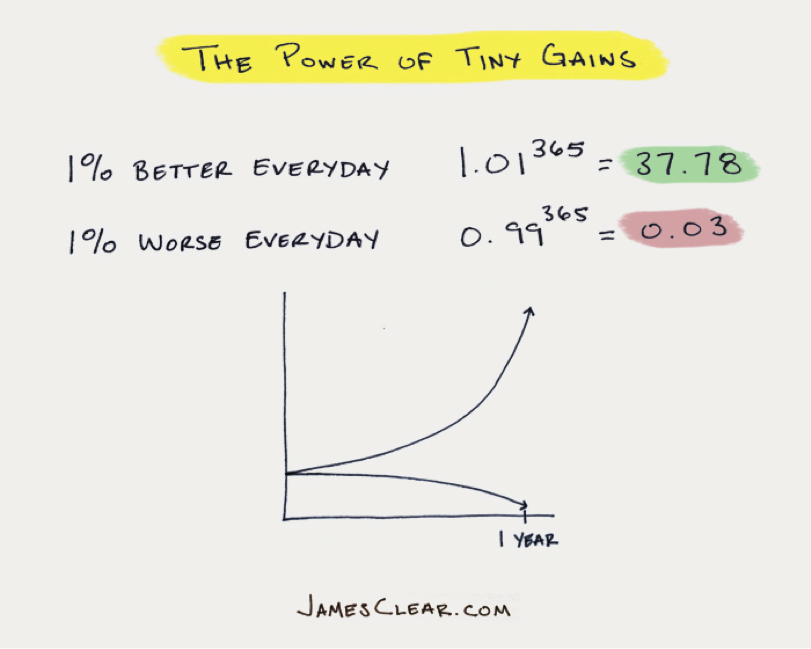 Just a 1% increase every day yields a 37x improvement by the end of the year.
If you want to build a habit of working out at the gym, first build the habit of just going to the gym. You can forget about actually working out for now. If you want to make morning jogging a habit, when you wake up just step outside.
Solidly acquiring a habit takes about 50 days. That’s because good habits apparently take 30–50 days to show effects.
From my own experience: in the first two weeks, don’t go all-out every time. For a gym workout, you don’t need an hour. 10 minutes is fine. For morning jogging, don’t even run 10 minutes — 1 minute is enough. Walking is OK if needed. Going all-out before the habit is set makes the next time much harder. As I said: action first, motivation second. Just act without thinking. You don’t need to raise the bar on yourself.
The key is to advance by just 1%. Minimize the habit, make it easy, and do just 1%. The trick is not to overdo it. Keep doing 1% every day and after 365 days you’ve grown 37×.
8. Frequency, Not Total Count
Good habits, of course, take time to show effects. Ironically, bad habits show their effects instantly.
No matter how small or simple, focus on keeping the habit high-frequency.
“How many days until a habit forms?” is the wrong question. “How frequently did you do it?” is what matters. Not total count — frequency is the crux.
My most recommended approach: do it daily in the early stage.
As I wrote in yesterday’s entry, output is the same. Simple, low-quality — it doesn’t matter. Continuing every day is what matters. I want to keep this blog going every day too.
Summary
This time I summarized what’s needed to acquire good habits.
There are good methods for building good habits.
By being mindful of these, I was able to build the habit of working out at the gym three times a week.
This year, I want to try Vlogging and posting videos too, so I’ll try shooting a simple video every day as a new habit to acquire.
Get the skill of acquiring good habits, and enrich your life.