Nov 30, 2018
Reading 'The Future Where YouTubers Disappear: Seeing the World in 2028' — Steeling Myself for Chaotic Times
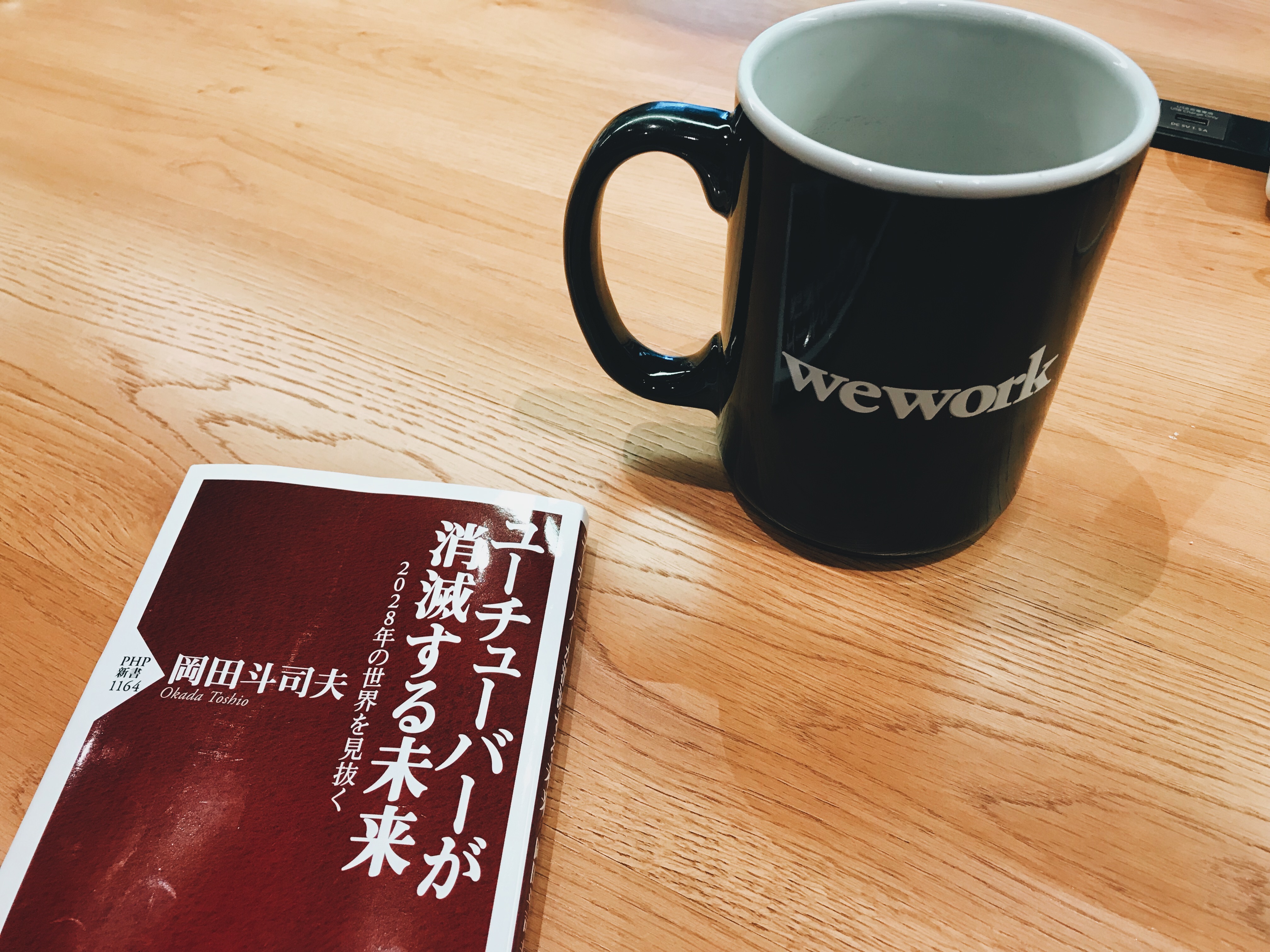
Today too, with love from pair reading, I’m writing this entry.
I’m at WeWork’s Iceberg location, and the English drifting in from around the room and the foreign users have a real cool vibe.

Japan can produce a foreign-feeling atmosphere too. I thought it would be a hardware problem, but maybe it’s more of a software problem than I expected. Of course, high ceilings = justice. Open feel = justice. Happy-hour beer = justice.
So.
Today was actually a pair-reading doubleheader. It uses more concentration than reading alone, so my brain is fried.
The book we read this time is “The Future Where YouTubers Disappear: Seeing the World in 2028,” a paperback. It’s Toshio Okada’s latest.

PHP研究所
売り上げランキング: 4,199
There was an interesting passage at the beginning, so let me pull it out. I’d love to dig into every section, but the opening alone was more than enough this time.
(I got hooked by the power phrase “Three Principles for Predicting the Future” — keep that between us.)
Three Principles for Predicting the Future
- First-impression supremacy
- Search rather than think
- No need for the middle
1. First-Impression Supremacy
First-impression supremacy means treating the very first impression and the emotion that arose at that moment as absolute.
Watching the internet, this really does feel right. It overlaps with the idea that “90% of a person is their appearance.”
The nasty part is that with the spread of the internet, a fair amount of preconception forms before you ever gather any primary information offline — and the verdict is in before you start. The cognitive bias is bigger than you’d imagine, and it spreads to others.
Crowds biting on clickbait headlines, fake news firestorms — this vector seems to be accelerating.
In the early days of the internet, people said “online society will just gather people with similar hobbies and views.” Today’s internet is beyond that.
In an era where everything is shifting from centralization to distribution, examples of AI assisting personal customization are also growing. Rationally, it’s wonderful and convenient to be able to consume things personalized for you. Very productive. Yay.
But life isn’t fun that way. In a world becoming hyper-rational through technology, I believe noise and randomness will act as the spice of life. The fact that people get fired up about meaningless, irrational things also fits this current, I think. That’s also an art context. YouTube timeline — please don’t optimize for me too much. Ideas explode when content goes in totally different directions.
※ Yeah, this book’s title is using that principle really well.
2. Search Rather Than Think
Instead of thinking up the answer yourself, you’ve come to select from the many opinions out there the one that fits you.
Japanese people are generally very good at reading the air. The flip side is that they’re really bad at stating their own opinions. Thrown into the global market, this trait makes you very fragile.
The 2010s world is one where every country is putting itself first, and the ideals of the United Nations are long gone… US President Trump, Russia’s Putin, Philippines’ Duterte, North Korea’s Kim Jong-un, Germany’s Merkel… the heads of major nations are all “strong characters.”
In a society filled with anxiety, you can’t survive — can’t keep your sense of self — without brazenly asserting yourself.
Thanks to the internet, we’ve gotten a system to broadcast our opinions to an unspecified audience. Without worrying about what’s around you, you hold your own opinion and put it out there. That’s the starting line. And then, the power to declare the values you believe in, raise a flag, and lead a fan base. That’s how you become a guru. These are becoming critical skills for living in this era.
You there — will you “grow your influence and build your own ‘country’” or “follow whoever built one”? It’s your choice. Both are valid choices and both can be happy ways to live.
3. No Need for the Middle
In other words, the super-first-tier survives, and everything else can be replaced by free volunteers — that era is here. What disappeared are the middle-tier pros who used to make a decent living.
It’s not just manga and media — content and services that once cost money becoming free. Even if you don’t know the taste of the no-name ramen shop in your neighborhood, you know the taste of major chains like Ippudo or Ichiran through convenience store cup noodles. Same thing.
As virtual quality improves, “virtual is way better than half-baked real” becomes the norm.
Even if you don’t know real sex, romance, or friendship up close, the free virtual relationships you can get might just become better.
It’s not that this choice is made because of a lack of money or connections — the more capitalist you become, the more you’ll make those choices. They strongly think in terms of ROI, which accelerates the trend.
Recognize the Future Gap
Inequality keeps growing in the world, but income and education are just outcomes. The essence is the “future gap” — gaps born from sensitivity to the future. Whether you’re always aware of how the future will unfold and can reflect that in your actions.
Nobody knows the future — that’s true. But it’s also undeniable that the status quo won’t continue as is.
Given this, I have to close today’s post with the words of Alan Kay, the father of the personal computer.
“The best way to predict the future is to invent it.”
PHP研究所
売り上げランキング: 4,199